A clinical trial of cranial electrotherapy stimulation for anxiety and comorbid depression
Barclay TH, Barclay RD.
Journal of Affective Disorders. 2014; 164:171-177.
Device Used
Alpha-Stim®
Key Variables
Anxiety, Depression
Author Affiliations
Department of Psychology, Liberty University, Lynchburg, VA; Analytics and Decision Support at Stetson University, Daytona Beach, FL.
Objective & Design
Objective: The purpose of this study was to examine the efficacy of CES for the treatment of anxiety and depression.
Design: This was an IRB approved 5 week study that used a randomized, sham controlled, double-blind design in which subjects in the treatment and sham groups participated in a daily one hour treatment of CES using active or sham Alpha-Stim CES devices. The sham device was identical to the active CES device, except it did not conduct an electrical current. The active CES device was set to 100 µA, a subsensory level. The subjects, investigators, physicians and staff were all masked as to the identity of the device.
Outcome Measures
Primary Outcome Measure
- The primary effectiveness endpoint was the change from baseline in the last post-treatment scores on the Hamilton Anxiety Rating Scale (HAM-A) compared to the sham treatment at the endpoint of the 5 week study.
Secondary Outcome Measure
- The secondary outcome measure was the change from baseline in the last post-treatment scores on the Hamilton Depression Rating Scale (HAM-D17) compared to the sham treatment at the endpoint of the 5 week study.
Key Inclusion Criteria
- Male and female participants between 18-65 years of age.
- Diagnosis of an anxiety disorder was verified by a licensed clinical psychologist in an interview using the DSM-IV criteria.
- Must score > 15 on the HAM-A.
- Score on HAM-A must be higher than score on the HAM-D17.
- If on antidepressant medication, the medication and dose must be stable for at least 3 months before entering study.
- Must be in good health; chronic medical conditions must be stable.
Key Exclusion Criteria
- Pregnancy, planning to become pregnant or nursing.
- Presence of implanted pacemakers, pumps or electrical stimulators.
- Use of Benzodiazepines more than twice per week.
- Met DSM-IV criteria for an Axis I diagnosis, other than an anxiety disorder.
- Participant judged by investigator to be a risk for suicide or has attempted suicide one or more times within the past 12 months.
- Current alcohol or substance abuse.
- Participants exhibiting a psychiatric condition that would require inpatient or partial psychiatric hospitalization.
Protocol Summary
The Alpha-Stim CES active and sham devices were randomized by the manufacturer and the devices were packed in the device box in the order which they were to be assigned. Subjects were assigned a device based on the order the devices came out of the box. Baseline measures were done prior to the first CES treatment. Subjects had 5 weeks of daily CES treatment for 60 minutes with either an active or sham device. Outcome measures were done at the end of 1, 3 and 5 weeks.
Results
Subjects: Of the 115 subjects who enrolled in the study, 108 subjects completed the study. There were 57 subjects in the active CES group and 51 subjects in the sham CES group.
Baseline Measurements: There was no statistically significant difference at baseline between active CES and sham treatment groups on anxiety, depression and subject characteristics of age, gender, use of prescribed medication and type of anxiety or depression disorder.
Anxiety
There was a significant difference between the active and sham groups for anxiety from baseline to endpoint of study (p<0.001, d=0.94). The HAM-A scores decrease in the active group of 16.14 (29.51 to 13.37; 54.6%) was more than 2 times the mean decrease of 7.58 (27.56 to 19.98; 27%) on the HAM-A for the sham group. Eighty-three percent (83%) of the active CES group had a decrease of ≥ 50% decrease in anxiety scores on the HAM-A from baseline to endpoint of study.

Depression
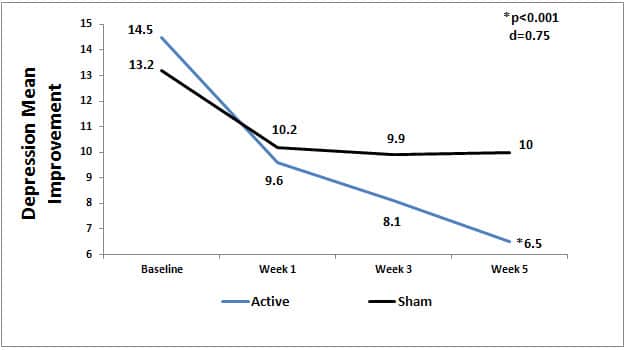
There was a significant difference between the active and sham groups for depression from baseline to endpoint of study (p<0.001, d=0.78). The HAM-D17 scores decrease in the active group of 8.04 (14.5 to 6.47; 55.4%) was more than 2.3 times the mean decrease of 3.26 (13.22 to 9.96; 24%) on the HAM-D17 for the sham group. Eighty-two percent (82%) of the active CES group had a decrease of ≥ 50% decrease in depression scores on the HAM-D17 from the baseline to the endpoint of study.
Conclusion
The results of this study confirm that CES is an effective treatment for anxiety and comorbid depression. The active CES group had significantly lower scores on the HAM-A and HAM-D17 from baseline to endpoint of study than the total sham CES group, demonstrating substantial improvement in mood status.
Quality of the Research & Limitations
This is a strong study that used a randomized, sham controlled, double-blind design and was adequately powered. Active and sham Alpha-Stim devices were pre-set and locked at the designated levels. A limitation of the study is that the number of individuals within the total groups who met the DSM-IV criteria for depression specifically was small (12 in the active CES group and 11 in the sham group), however the total active CES group had significantly lower scores on the HAM-D17 indicating improved mood status overall.
Study Quality: STRONG
Experience the Clinical Benefits of Alpha-Stim
Join thousands of patients finding safe, drug-free relief from anxiety, insomnia, depression, and pain.