Efficacy of Cranial Electrotherapy Stimulation on Anxiety and Sleep Qualities Among Elderly Patients with Chronic Sleep Disorders
Ren, Y., Zhu, Y., Yang, J., & Ding, F.
Chinese Journal Modern Nursing. 2019; 25(24).
Device Used
Alpha-Stim® SCS
Key Variables
Anxiety & Sleep
Funding Source / Location
Geriatric Department and Nursing Department, the First Affiliated Hospital of Chongqing Medical University, Chongqing, China.
Objective & Design
Objective: To explore the effects of cranial electrotherapy stimulation (CES) on anxiety and sleep quality among elderly patients with chronic sleep disorders.
Design: A randomized controlled trial of 120 elderly patients with chronic sleep disorders was randomly divided into a control and treatment group, with 60 cases in each group. The control group MED received treatment-as-usual (TAU) that involved medication, either clonazepam or ramelteon. The treatment group CES received a course of CES treatment constituting once daily, 20 minutes session, over 12 weeks. The sleep quality and anxiety of patients in the two groups were evaluated using the Pittsburgh Sleep Quality Index (PSQI) and the Hamilton Anxiety Rating (HAM-A) scale before treatment and after a course of treatment.
Outcome Measures
Primary Outcome Measure
- Sleep quality: Measured by the PSQI, a 19-item scale to measure sleep quality and disturbance over two weeks. Higher PSQI scores indicate poorer sleep quality.
- Anxiety: Measured by the HAM-A scale before treatment and after a course of treatment.
Secondary Outcome Measure
- None reported.
Key Inclusion Criteria
- Sleep disturbance meeting CCMD-3 criteria for insomnia
- Latency to persistent sleep (LPS) >30 minutes
- Actual sleep time <6 hours every night
- Disease course of >6 months
- Aged ≥ 60 years
Key Exclusion Criteria
- Significant or severe organ dysfunction
- Severe cognitive disorders
- Sleep apnea syndrome
- Sleep disorders caused by severe mental disorders
- Not taking psychotropic drugs within 2 weeks before the start of the study
Protocol Summary
A group of 120 elderly patients with chronic sleep disorders was randomly divided into a control group (n=60 MED) receiving standard medical care that involved medication and an experimental treatment group (n=60 CES) that received a course of CES treatment constituting a once-daily, 20 minutes session, over 12 weeks.
- MED Group: Patients took sleep medication as prescribed by their doctor – typically 2mg qd hs of Clonazepam or 4mg qd hs Ramelteon every day.
- CES Group: Received CES treatment using the Alpha-Stim® SCS for 20 minutes before falling asleep every day for 12 weeks.
Results
Subjects: A total of 52 patients in the MED group and 55 in the CES group completed the study. Baseline comparison measures showed no statistically significant differences between the patients in each group (p>.05).
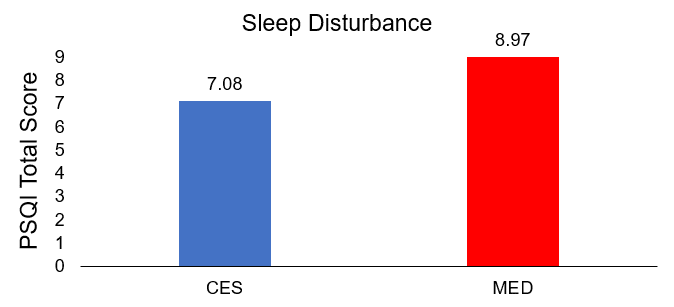
Data Analysis: The results showed that the therapeutic effect of CES was better than that of traditional drug therapy (p<.001). After the intervention, the total PSQI scores of the treatment group (CES) were lower (7.08±0.98) than those of the control group (MED) (8.97±1.38), indicating greater improvement in sleep quality.
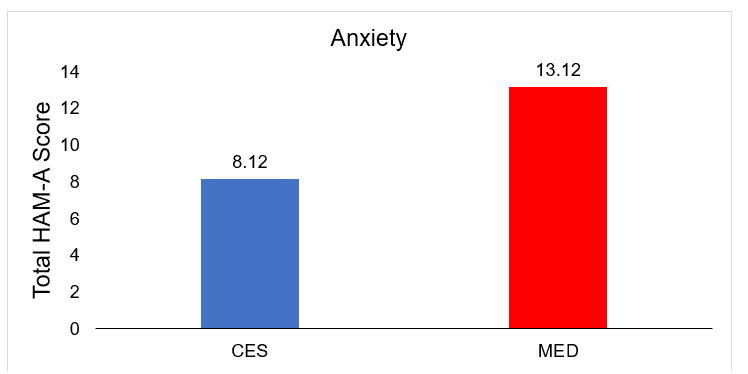
Moreover, according to HAM-A scores, CES treatment was better than the MED group at improving sensory system symptoms, gastrointestinal tract symptoms, genitourinary system symptoms, and autonomic nervous system symptoms, etc. (p<.001).
Conclusion
The authors conclude that, compared with traditional medication treatments, CES more effectively improves sleep quality and reduces anxiety in elderly patients with chronic sleep issues, without adverse reactions. The results of the HAM-A demonstrate CES also improved the physiological symptoms of anxiety more effectively than medication.
Limitations & Study Quality
Limitations: Only the post treatment scores on the PSQI and HAM-A are provided, so the progress throughout the 12-week treatment period cannot be determined. Additionally, participants in the CES condition treated before going to bed, despite the Instructions for Use (IFU) for Alpha-Stim advising against treating within 3-4 hours of going to sleep.
Study Quality: FAIR
Experience the Evidence
Join thousands of others who have found relief with Alpha-Stim's clinically proven technology.