Cranial electrotherapy stimulation affects mood state but not levels of peripheral neurotrophic factors or hypothalamic-pituitary-adrenal axis regulation
Roh, HT. & So, W-Y.
Technology and health care. 2017; 25(3):403–412.
Device Used
Alpha-Stim® 100
Key Variables
Changes in neurotrophic factors and mood
Funding Source / Location
Sports and Health Care Major, College of Humanities and Arts, Korea National University of Transportation, Chungbuk, Korea.
Objective & Design
Objective: To evaluate changes in the hypothalamic-pituitary-adrenal (HPA) axis response and levels of neurotrophic factors, blood cortisol, adrenocorticotropic hormone (ACTH), neurogenesis, and neuroplasticity; as well as changes in mood state, in patients undergoing Cranial Electrotherapy Stimulation (CES) therapy.
Design: A randomized controlled trial (RCT) designed to assess changes in the HPA axis response and levels of neurotrophic factors, and changes in mood states following a period of eight weeks of treatment in a Sham comparator and Active CES group. Blood samples were collected before and following treatment and changes in mood state in both groups.
Outcome Measures
Primary Outcome Measure
- Baseline and eight-week post-treatment levels of Cortisol, Adrenocorticotropic Hormone (ACTH), Brain-Derived Neurotrophic Factor (BDNF), and Nerve Growth Factor (NGF).
Secondary Outcome Measure
- Changes in mood state were examined at the time of blood collection using the Korean version of Profile of Mood States (KPOMS).
Key Inclusion Criteria
- Body mass index (BMI) under 30kg/m2
Key Exclusion Criteria
- Significant history of medical problems, drug use, or mental illness
- Chronic diseases such as hypertension or diabetes
- History of smoking
- Participation in a regular exercise program in the last six months
Protocol Summary
Participants were randomly assigned to either a Sham CES group (n=25) or an Active CES group (n=25). Randomization of each group was conducted using a simple online randomization algorithm.
- Active CES Group: Received treatment with a current of 100 μA at a frequency of 0.5 Hz for 20-minute sessions, three times per week for eight weeks.
- Sham CES Group: The same procedure was followed, though the power of the device remained off.
Results
Subjects: Fifty (50) healthy postmenopausal women were randomly assigned to either a Sham CES group (n=25) or an Active CES group (n=25).
Data Analysis: Changes in hormones associated with HPA axis regulation and neurotrophic factors following CES treatment revealed no significant differences to levels of plasma cortisol, plasma ACTH, serum BDNF, and serum NGF, or interaction between time and group following CES treatment (p>0.05).

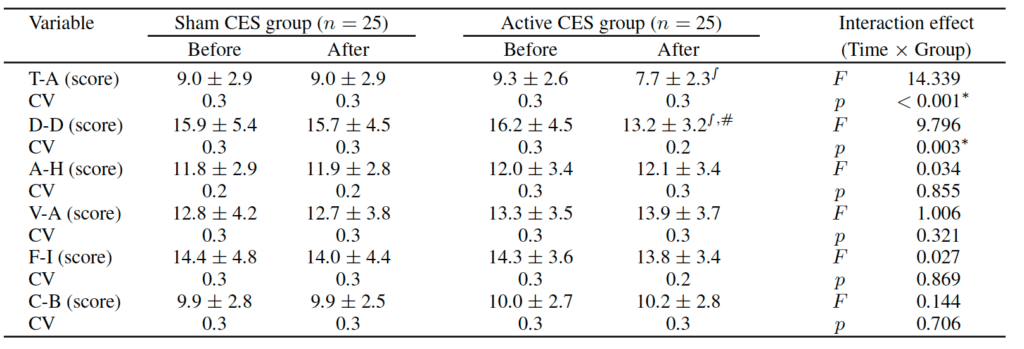
Two-way repeated-measures ANOVA for mood states and interaction between time and group revealed significant differences in Tension-Anxiety (p<0.001) and Depression-Dejection scores (p<0.003) following CES treatment. Post-hoc analysis revealed significant decreases in Tension-Anxiety and Depression-Dejection scores (p<0.05) in the Active CES group. Furthermore, Depression-Dejection scores were significantly lower in the Active CES group than in the Sham CES group (p<0.05) following treatment.


Conclusion
The authors concluded that their results suggest that eight weeks of CES treatment does not induce changes in blood levels of neurotrophic factors or HPA-axis-related hormones, though such treatment may be effective in treating symptoms of anxiety and depression. The absence of significant changes in plasma cortisol or ACTH levels are at odds with patient reports of significant improvement in mood states related to anxiety and depression.
Limitations & Study Quality
Limitations: The CES protocol utilized in this study is not consistent with other studies or with clinical instructions for use regarding current intensity and duration of treatment. At 100 uA, 60 minutes of treatment is recommended, not 20 minutes. Additionally, it is likely that a longer-term study is needed to demonstrate chemical changes from Alpha-Stim CES treatment. The authors also do not discuss a plan for missing data in their statistical analysis.
Study Quality: FAIR
Experience the Clinical Benefits of Alpha-Stim
Join thousands of patients finding safe, drug-free relief from anxiety, insomnia, depression, and pain.