Feasibility, acceptability and costs of nurse-led Alpha-Stim cranial electrostimulation to treat anxiety and depression in university students
Authors: Royal, S., Keeling, S., Kelsall, N., Price, L., Fordham, R., Xydopoulos, G., et al.
Published In: BMC Primary Care. 2022; 23:97.
Device: Alpha-Stim® AID
Funding Source & Location
University of Nottingham Health Service, Cripps Health Centre, United Kingdom. Funded by National Institute of Health Research (NIHR), with the devices being loaned to the clinic by the manufacturer.
Objective
To evaluate the effectiveness and the cost effectiveness of a new medical device for the treatment of mild to moderate depression and anxiety in Primary Care when delivered through an innovative nurse-led clinic. Assess a group of participants attending the mental health clinic who used Alpha-Stim AID either alone or in combination with other treatments. Ispero was used to gather baseline PHQ-9 and GAD-7 scores and then compared this with a score taken after 8 (6-10) weeks of use.
Design & Protocol
The study evaluated the effectiveness of a new treatment without increasing the cost burden. It was conducted at a GP surgery in the City of Nottingham and ran for six months. A non-randomized controlled trial was chosen as it seemed more ethical than a randomized control trial. In addition, it would create logistical problems that would not outweigh the benefits in outcome data quality and comparability.
Device Application Protocol: Electrical stimulation was applied via ear clip electrodes at the lowest setting (0.5 Hz, 100 μA) based on previous positive studies of the device for depression and anxiety. Treatment was delivered for between twenty minutes and one hour each day. Study Duration: Over 6-10 weeks, with measurements taken at 8 weeks.
Primary Outcome Measures
To compare PHQ-9, GAD-7 and satisfaction survey responses in the experimental group with a selection of patients receiving usual care in an ad-hoc control group.
Results
Subjects
- Active Cohort: 47 young people (mean age 21.4 years, 77% female) contributed data to the active part of the study.
- Comparator Control: A sample of 47 control group scores were identified. The mean age of this group was 22.7 years and 79% were female.
Data Analysis & Efficacy
Intention to treat and completed group analyses was performed for the behavioral measures.
Anxiety (GAD-7): The mean baseline in anxiety was a GAD7 score of 13.6 and the mean score after treatment was 8.5. This improvement was significant at p<0.05. In the control group, the mean baseline GAD7 score was 12.9 and the mean post-treatment score was 8.7, a significant (p<0.05) decrease. These results show that Alpha-Stim CES is as effective as the NHS usual treatment pathways for GAD.
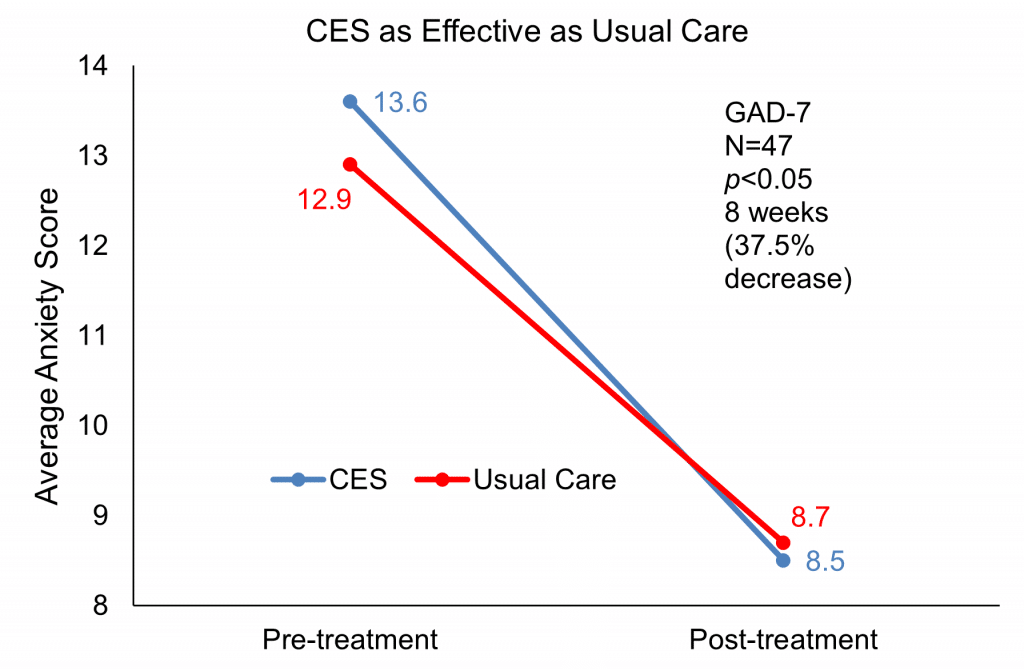
Change in average GAD-7 anxiety score from pre to post treatment.
Depression (PHQ-9): The mean baseline in depression was a PHQ-9 score of 15.35 and the mean score after treatment was 11.24 – representing an improvement that was significant at p<0.001. No PHQ-9 scores are reported for the control group.
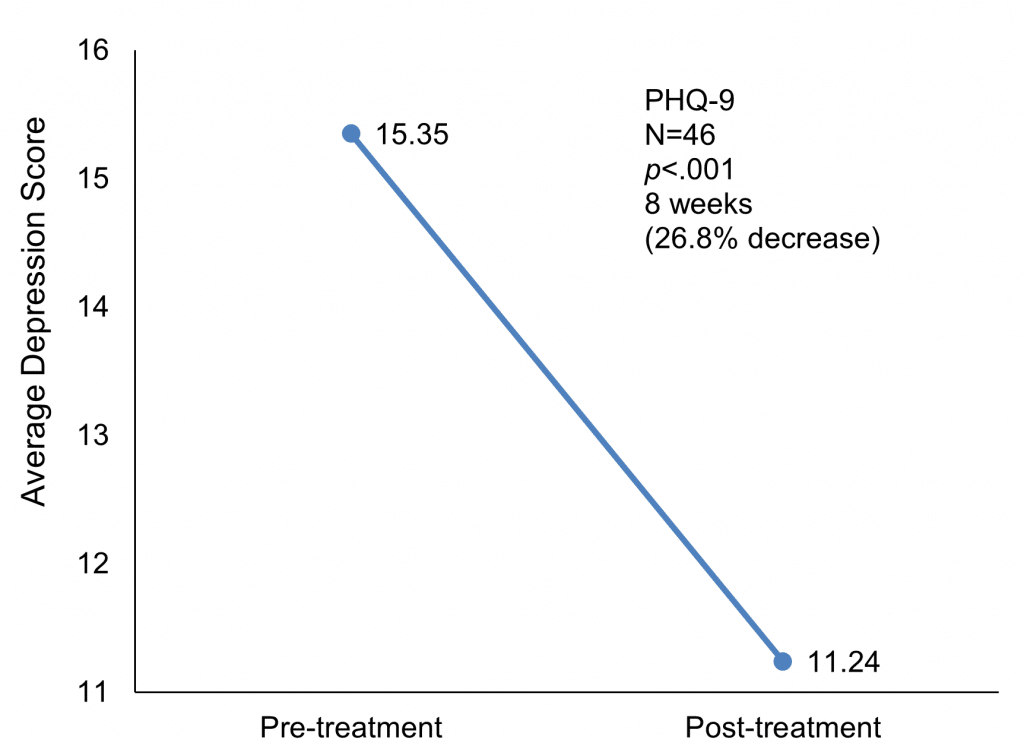
Change in average PHQ-9 depression score from pre to post treatment.
Conclusions
The results of this study suggest that a care pathway incorporating Alpha-Stim was non-inferior to usual care and may indeed be slightly better in terms of mean reduction of PHQ-9 and GAD-7 scores.
The researchers estimated that a 20-minute appointment in the nurse-led clinic costs £23.67 ($30.41) and that a 20-minute appointment with a doctor as part of usual care calculated by the same formula is £42.61 ($54.75). Given the similar rate of consultation the authors believe the Alpha-Stim pathway represents a significant cost saving likely to be in the region of 10-20% allowing for fewer and shorter consultations in the usual care group.
No adverse events were reported during the trial and nine patients expressed a high degree of satisfaction with their Alpha-Stim treatment in solicited feedback collected at the end of the study. No negative feedback was received.
Limitations
Given this study included a sample of patients presenting to primary care, participants were not able to be randomly assigned to CES or usual care groups.